TL;DR
- This blog is for job seekers, students, career changers, and professionals who want to understand the difference between a resume and a cover letter to improve their job applications.
- A resume presents a structured, factual summary of your skills, experience, and qualifications, while a cover letter is a personalized document that explains your motivation and why you're a strong fit.
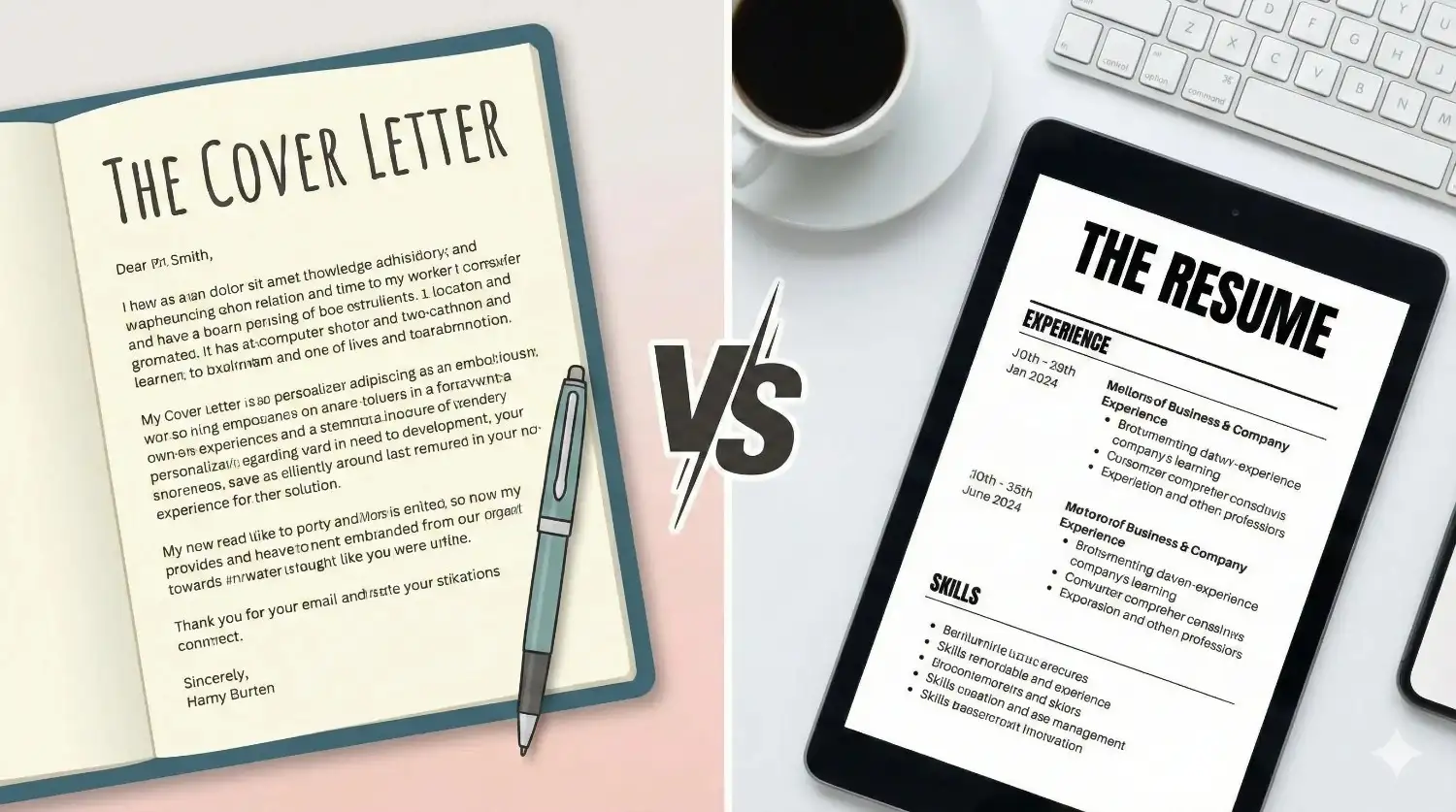
- The two documents differ in purpose, tone, length, and format: resumes use bullet points and are concise, while cover letters use full sentences and offer context and storytelling.
- Using both together strengthens your application—your resume markets your skills, and your cover letter highlights your personality, enthusiasm, and reasoning.
- Common mistakes to avoid include repeating content in both documents, writing generic cover letters, skipping proofreading, ignoring job-specific keywords, or not tailoring each document to the role.
Introduction: Why Understanding the Difference Matters
Applicants need to present themselves in the best way that is clear, confident, and professional. Your resume and your cover letter are two important documents that are critical towards creating a first impression with a recruiter. However, many job seekers still struggle to understand the difference between a resume and a cover letter and often use them interchangeably.
The average resume scan time of most recruiters is 6–8 seconds, with cover letters typically reviewed for 15–30 seconds. This means both documents must be clear, specific, and strategically written—not duplicates of each other.
However, there are numerous job hunters who compose their cover letters in a resume-like manner and their resumes in a cover letter manner. Some others do not even need to write the cover letter since they are not aware of its usefulness.
This confusion leads to common questions like:
- Is the cover letter and resume the same?
- What is a resume letter?
- What is a cover letter for a resume?
- What is the difference between a cover letter and resume?
This is a complete guide on how a resume and cover letter differ, how to use each strategically, and how knowledge of the differences can help you drastically increase your chances of landing a job.
Before applying for your next job, it's essential to know:
- What each document is
- Why both are important
- The difference between cover letter and resume
- How these differences influence your job prospects
Mastering the distinction helps you showcase your strengths more effectively and communicate your professional identity with confidence.
What Is a Resume?
A resume is a concise document that outlines your professional history. It highlights your skills, experience, education, accomplishments, and qualifications in a structured, skimmable format.
Many people refer to it informally as a "resume letter." So if you're wondering what a resume letter is, the answer is simple: it is the same as a resume, just another name used to describe the document summarizing your work background.
Purpose of a Resume
A resume serves one primary goal: to give the recruiter a snapshot of your qualifications at a glance. It is NOT meant to tell your entire story. It should highlight only the most relevant information that supports your application.
Key Elements of a Resume
A typical resume includes:
- Contact information
- Professional summary or objective
- Work experience
- Skills (technical + soft skills)
- Education
- Certifications
- Achievements
- Tools and technologies
- Relevant projects (optional)
Why Recruiters Need Resumes?
Recruiters rely on resumes to:
- Quickly screen candidates
- Determine if you meet the job requirements
- Assess your career progression
- Evaluate your skills and accomplishments
- Compare multiple applicants
A resume is your professional snapshot, a marketing document designed to highlight your best qualifications efficiently.
What Is a Cover Letter?
A cover letter is a formal one-page letter, which is personalized and sent together with your resume. It provides the reasons as to why you are applying, why you are a good fit, and why the company needs to consider you rather than the other applicants.
If you're wondering what a cover letter does in relation to a resume, then it is just an introduction letter that puts your resume in perspective, story, and character.
Key distinction:
- A resume shows your qualifications
- A cover letter shows your motivation, communication skills, and reasoning
Purpose of a Cover Letter
A cover letter helps you:
- Introduce yourself professionally
- Explain why you are applying for the job
- Demonstrate your enthusiasm for the role
- Clarify career gaps or transitions
- Highlight specific achievements in a personalized manner
- Show cultural and team fit
What a Cover Letter Should Include?
A well-written cover letter typically contains:
- Hiring manager's name
- A compelling opening paragraph
- A brief introduction of your background
- Why you're a perfect fit
- How your skills match the job
- A short story or example of success
- A strong closing paragraph
Unlike a resume, a cover letter allows you to write in complete sentences, focus on storytelling, and demonstrate emotional intelligence.
Why Recruiters Value Cover Letters?
Even when optional, cover letters increase your chances of getting shortlisted. They help recruiters evaluate:
- Your writing skills
- Your passion for the company
- Your seriousness about the opportunity
- Whether you understand the role
- Your professionalism and communication style
Why Write a Cover Letter?
A cover letter provides an opportunity to justify why you desire the job and why you are the most suitable, and your resume would not achieve this. It brings character to your application, demonstrates your drive, and enables you to give important accomplishments a background. A cover letter also allows you to clarify any career gaps or changes, show your ability to communicate, and show that you have taken the time to research the company. To the point, it makes you more memorable and your general application more powerful and persuasive.
✔ Shows your motivation for the job
A cover letter explains why you want the role and why you're excited about the company, something a resume cannot convey.
✔ Gives personality to your application
While a resume is factual, a cover letter lets you express enthusiasm, confidence, and professionalism.
✔ Allows you to highlight your best achievements
You can pick one or two standout accomplishments and explain the story behind them.
✔ Provides context for your career path
A cover letter helps you explain career gaps, job changes, relocations, or transitions smoothly and professionally.
✔ Helps you stand out from other candidates
Many applicants skip the cover letter, so writing one gives you an immediate advantage.
✔ Shows you've researched the company
Recruiters appreciate candidates who understand the company's mission, values, or challenges.
✔ Demonstrates communication skills
A clear, well-written cover letter shows you can communicate effectively—something employers value highly.
✔ Connects your experience directly to the job description
You can explain how your skills specifically match the role and why you're the right fit.
✔ Creates a professional first impression
A personalized cover letter signals seriousness, effort, and commitment to the opportunity.
What to Include in a Cover Letter?
Header with contact information
Your name, phone number, email, location, and date.
Employer's details
Hiring manager's name, title, company name, and company address (if available).
Personalized greeting
"Dear [Hiring Manager's Name]," or "Dear Hiring Team," if the name is unknown.
Strong opening paragraph
Introduce yourself and state the job you're applying for. Mention a key strength or achievement to grab attention.
Brief summary of your relevant background
Highlight your most important skills and experiences related to the role.
One or two key achievements
Provide short examples that demonstrate your results, impact, or expertise.
Why you want the job
Explain what interests you about the role and what attracts you to the company.
Why you're a great fit
Connect your skills and experience directly to the job requirements.
Company knowledge
Show that you've researched the company, its mission, or its goals.
Professional closing paragraph
Express interest in an interview and thank the employer for their time.
Formal sign-off
"Sincerely," followed by your full name.
Cover Letter vs Resume: What's the Difference?
A resume provides a brief overview of what you can do, what you have done, and what you have accomplished in a well-organized format—most commonly through bullet points. However, a cover letter is a personalized letter, which justifies why you are applying to the job and why you are a good fit. The resume just concentrates on what you have achieved whereas the cover letter justifies the reasons why it is important as well as why you are the best option. Both reports combine to produce a powerful, complete job application.
What is the difference between resume and cover letter?
The difference lies in:
- Purpose
- Tone
- Length
- Content
- Format
- Depth of detail
Here is a breakdown:
Purpose Difference
Resume → Summarizes your qualifications
Cover Letter → Convinces the employer to read your resume and invite you for an interview
Tone Difference
Resume → Formal, factual, concise
Cover Letter → Conversational, persuasive, personalized
Content Difference
Resume → Skills, experience, achievements
Cover Letter → Motivation, reasoning, personality, examples
Length Difference
Resume → 1–2 pages max
Cover Letter → 1 page
Format Difference
Resume → Bullet points, sections, headers, metrics
Cover Letter → Paragraphs, sentences, letter structure
Detail Difference
Resume → "What" you did
Cover Letter → "Why" it matters
When to Use a Resume, a Cover Letter, or Both?
Almost any job application needs a resume as a form of summary of your skills and work experience in a structured manner within a short time. A cover letter is however applicable in cases where you would like to give a more personal introduction of you and reasons as to why you would need the position or why you would fit the job. You are expected to provide both when required by the job description, as part of an application to an individual hiring manager, or when you are simply trying to shine in a job market that is competitive. Put simply, you should use a resume to demonstrate your qualifications, a cover letter to demonstrate your motivation, and use both to create the best impression.
When Only a Resume Is Needed
- When applying through job portals
- When the employer does not request a cover letter
- When making general job submissions
When a Cover Letter Is Essential
- When the job posting specifically asks for it
- When applying directly to HR or a hiring manager
- When switching careers
- When addressing employment gaps
- When applying to high-competition roles
Best Practice
Always include a cover letter unless instructed otherwise. It shows effort, professionalism, and interest.
Is Cover Letter and Resume Same?
A resume is a structured summary of your skills, work experience, education, and accomplishments. A cover letter, on the other hand, is a personalized letter that explains why you're applying, why you're a good fit, and why the employer should consider you.
Simple difference:
Resume = WHAT you have done
Cover Letter = WHY you're the right choice
Tips to Make Your Resume and Cover Letter Work Together
Use Matching Keywords
Ensure both documents reflect the job's keywords naturally.
Highlight Achievements in the Resume
Use metrics such as:
- Increased sales by 40%
- Managed 12-member team
- Reduced costs by 25%
Tell the Story Behind Your Achievements in the Cover Letter
Explain the context, challenge, and impact of your work.
Ensure Tone Consistency
Both documents should reflect the same professional identity.
Address Company Needs
Both the resume and cover letter should align with the employer's requirements, not yours.
Common Mistakes to Avoid When Creating a Resume with a Cover Letter
Most candidates undermine their employment applications by duplicating the same information in their resume and cover letter, and this gives the impression of being unprofessional and unprepared. The other frequent error is writing a cover letter as a resume, writing in bullet points rather than a custom-made letter. Other applicants do not even customize their documents to the job and thus they are too generic to leave an impression on the recruiters. Some of them do not even include a cover letter at all—even in cases where it might prove useful in explaining career gaps, job changes, or motivation. These are some of the mistakes that you should avoid so that your resume and cover letter can work in tandem to make your application better.
❌ Repeating the same information in both documents
Avoid copying your resume into your cover letter. Each should provide different value.
❌ Using a generic cover letter for every job
Recruiters can instantly tell when a letter isn't tailored to the company or role.
❌ Making the cover letter too long
A cover letter should be one page only—brief, focused, and engaging.
❌ Writing the cover letter like a resume
A cover letter should not use bullet points or list-style writing. It should tell a story.
❌ Using an unprofessional tone
Resumes should be formal; cover letters should be professional but conversational.
❌ Not matching the style and formatting
Your cover letter and resume should look like they belong together—same font, layout style, and header formatting.
❌ Failing to explain career gaps or major transitions
The cover letter is the perfect place to provide context that a resume cannot.
❌ Ignoring the job description keywords
Resumes and cover letters should reflect the same core keywords and requirements.
❌ Including irrelevant personal details
Avoid unrelated hobbies, personal stories, or information that does not support your application.
❌ Not using metrics in the resume
A resume should include measurable achievements, while the cover letter can explain them.
❌ Skipping proofreading
Grammar, spelling, and formatting errors in either document can lead to immediate rejection.
❌ Not addressing the hiring manager directly
Whenever possible, personalize the greeting in your cover letter to show professionalism and effort.
❌ Submitting a resume without a cover letter (when it's optional but helpful)
Sending a cover letter can significantly increase your chances, especially in competitive roles.
Final Thoughts: Why Knowing the Difference Matters
Understanding the difference between a resume and cover letter is essential for all job seekers. Your resume serves as your professional snapshot, while your cover letter serves as your professional voice.
Resumes and cover letters are two distinct elements that are necessary to compose a good and effective job application. Your resume, with all of the qualifications, skills, and experiences, is something that emphasizes what you are and what you are not, and your cover letter is something that brings personality, context, and motivation. They are most effective when used together because they give employers a complete, persuasive picture of why you're the right candidate. The process of customizing the two forms, preventing the errors, and making your value obvious will help you increase your likelihood of being better than your peers and securing the interview.
Both documents play unique, complementary roles:
- The resume markets your skills
- The cover letter markets your personality
- Together, they market your story
Once you master resume vs cover letter, you'll be able to create compelling applications that inspire recruiters to take action and call you for interviews.