TL;DR
- This guide is designed for professionals, students, and career changers who want to apply for international jobs and need a globally accepted resume or CV format.
- A strong resume for abroad uses global terminology, avoids personal details, removes regional jargon, and follows clean, organized formatting that works across countries.
- Resumes are preferred in the US, Canada, Australia, and Middle East (1–2 pages), while detailed CVs are expected in Europe and academic sectors (2–3+ pages). Choosing the right format boosts your interview chances.
- A winning international resume includes a strong summary, skills, measurable achievements, education, certifications, and optional sections like languages, projects, and volunteering.
- Skip photos (in US/UK/Canada), personal details, long paragraphs, and non-ATS designs. Use action verbs, quantify achievements, tailor your resume for each country, and follow global best practices.

Introduction: Why Your Resume Needs an International Upgrade?
The world of global hiring has undergone a drastic transformation in the last decade. Today, professionals are no longer bound by boundaries. Companies in the US, UK, Europe, the Middle East, Canada, Australia and Southeast Asia are active in hiring international talents. Despite this tremendous opportunity, many applicants still get rejected but not because they lack skills, but because they fail to follow the international resume format dictated by global employers.
A resume that works in India may not work in Germany. You could create a CV suitable for Dubai yet still face rejection in the US. Every country has its own expectations and knowledge of the international CV format is the key to appearing professional, international and competitive.
This comprehensive guide covers everything from global resume structures and region-specific rules to international CV and cover letter tips to real-life examples, from what recruiters are looking for to a step-by-step guide on how to make a CV for job applications abroad.
By the end, you will know exactly how to design a compelling, ATS-friendly and globally acceptable resume for abroad jobs.
Understanding the International Resume Format
The international resume format is the one that professionals can use when they are going to apply for jobs abroad. Unlike traditional local resumes, this is an internationally recognized, ATS-friendly format that is free of regional jargon. It follows global hiring practices by showing off your skills, achievements, and experience in a clean and results-based format. Because expectations vary by country, an international resume avoids unnecessary personal information and follows a universal layout that would fit any resume for international application.
Unlike local resumes, an international resume:
- Follows globally accepted standards
- Removes country-specific jargon
- Uses universal terminology
- Prioritizes clarity, structure, and professional presentation
- Avoids personal details that violate international hiring laws
- Is optimized for ATS (Applicant Tracking Systems)
- Meets the expectations of recruiters from different countries
Many countries use the word "resume," while others prefer "CV." However, outside India and the Middle East, CV generally means a longer academic document. For most global jobs, the shorter international resume format is used.
International Resume vs. International CV: Key Differences
One of the major aspects of building the right resume for abroad is the difference between an international resume and an international CV. An international resume is a brief, achievement-focused document based on the job and typically is 1-2 pages in length, for worldwide corporate work. It features your experience, skills, and achievements neatly presented in an ATS-friendly format.
On the contrary, an international CV format is more detailed and structured. It is usually 2–3 pages and is preferred in Europe, Germany, the UK and the academia field globally. A CV contains deeper sections like education, research job, languages, professional training etc. In some regions, it is common to include a photo or nationality, but these are not allowed in the US and Canada due to strict hiring laws
Choosing the correct format is very important when doing an application abroad. While resumes work best for corporate hiring in most countries, CVs are a must for academic jobs and European job markets. Understanding these differences is something candidates should account for when creating the right international CV and cover letter, in order to adhere to the global standards for hiring.
Resume
Used in US, Canada, Australia, Singapore, Middle East
- 1–2 pages
- Summarized
- Highlights skills + work experience
- Achievements are quantifiable
- Industry-focused
CV
Used in Europe, Germany, UK, Netherlands, some Asian countries
- 2–3 pages
- More detailed
- Includes academic background
- Includes research, training, or publications
- May include a professional photo (depends on country)
When applying globally, always check the specific international CV format for the country. A strong, well-aligned document will improve your interview chances significantly.
Universal Structure for an International Resume Format
A great international resume format is one that is clean, organized and internationally accepted and which makes your profile easy for recruiters and ATS systems to evaluate. While regional preferences differ, the basic layout is generally similar in countries such as the US, UK, UAE, Canada, Australia and Singapore. The goal is to present your experience, achievements, and skills clearly in a clear, concise, and professional way without adding additional information that may lead to rejection from abroad.
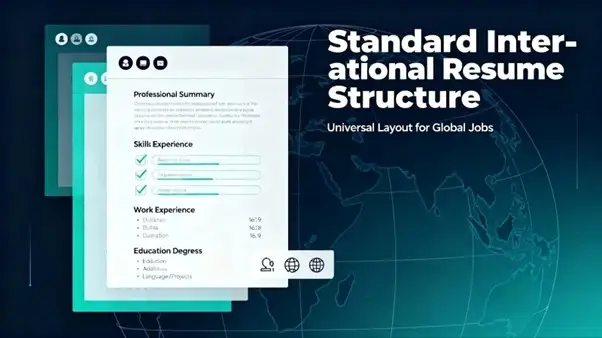
Standard International Resume Structure
1. Header & Contact Information
- Full name
- Country code + phone number
- Email (professional)
- Country of residence
- Visa/work permit status (optional but useful)
2. Professional Summary
A 3–4 line summary highlighting your experience, skills, and career goals.
3. Skills Section
- Technical skills
- Soft skills
- Tools and technologies
4. Work Experience
- Job title
- Company + location
- Years of employment
- Bullet points describing achievements using metrics
5. Education
- Degrees
- Institutions
- Certifications
6. Additional Sections
- Languages
- Projects
- Leadership experience
- Volunteering
- Awards
This universal structure ensures your document aligns with the international resume format accepted worldwide.
Region-Wise International CV Format Requirements
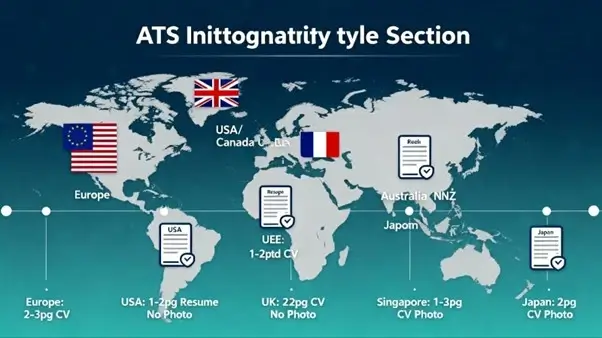
Understanding how different countries structure and evaluate resumes is key to succeeding in global job markets to anyone seeking employment abroad. While the international form of resume is a universal way of structuring the document, each region has its own expectations about formatting, length and personal details. Your chances of being shortlisted can be reduced greatly if you use the wrong format.
Europe (EU, Germany, Netherlands, France)
Europe prefers a detailed international CV format rather than a short resume. Employers across Germany, France, the Netherlands, and most EU countries expect a structured, transparent, and well-organized CV.
- Preferred document: CV
- Length: 2–3 pages
- Photo: Common (except UK)
- Template style: Europass or professional layouts
Key requirements:
- Detailed education section
- Language proficiency levels
- Skill matrices
- Clear chronology
United Kingdom
The United Kingdom has one of the most structured and conservative standards of resumes in the world. Employers in England, Scotland, Wales and Northern Ireland expect a tidy, to-the-point and achievement-focused CV.
- Preferred document: CV
- Length: 2 pages
- Photo: Not recommended
- Tone: Professional, concise
USA & Canada
The USA and Canada are the countries that follow the strictest guidelines for resumes as it is more about being able to tell your resume clearly, your achievements and being in line with hiring laws. Applicants must use an international resume format that is concise and ATS format suitable for North America.
- Preferred document: Resume
- Length: 1–2 pages
- Photo: Strictly not allowed
- Personal info: Age, gender, marital status prohibited
Middle East (UAE, Qatar, Saudi Arabia)
The Middle East follows a more flexible approach when it comes to resume formats and accepts both traditional resumes and detailed CVs. Countries such as the UAE, Qatar and Saudi Arabia tend to favor a slightly more descriptive format than western countries, particularly for mid to senior level positions.
- Preferred document: Resume or CV
- Length: 1–3 pages
- Photo: Optional
- Personal info: Nationality, visa status, languages often included
Australia & New Zealand
Australia and New Zealand have a very modern, international and achievement-oriented style of resume, which is clean, concise, and ATS-friendly. Employers in these countries want clarity, measurable results and relevant skills and not lengthy descriptions and personal information.
- Preferred document: Resume (international style)
- Length: 2–3 pages
- Photo: Not recommended
- Focus: Achievements and impact
Asia (Singapore, Japan, South Korea)
Asian hiring markets especially Singapore, Japan, and South Korea-expect structured, formal, and detail-oriented resumes. While formats vary slightly by country, all three value clarity, professionalism, and strong skill presentation.
- Preferred document: Resume or hybrid CV
- Length: 1–2 pages
- Photo: Optional depending on culture
- Type: High emphasis on professionalism
Writing an International CV or Resume When English Is Not Your First Language
Creating an international CV is challenging enough, but to do one in English when it's not your native language creates an additional level of challenge. To start writing your English language CV or Resume, you should first collect all the necessary information and tools you'll need.
Prepare the following before you start:
- Your existing CV in your first language
- Any new details or updates that you need to add
- The job description(s) you're targeting in order to study the terms and keywords
- Language support tools such as an English dictionary, thesaurus or translation apps such as Google Translate
- A good international CV template or a professional resume maker
When you are all set, start translating your information into English. Review some sample resumes for inspiration and take note of the tone and vocabulary and style that is typically used in global job applications. Incorporate relevant keywords from job description - This will help in ensuring that your CV is able to pass through automatic filters of ATS (Applicant Tracking System).
If possible, have a native speaker of English or someone who is fluent in English review your end document. They can help you polish your sentence structure, fix grammar and clarify cultural nuances before you submit your international resume to employers around the world.
What to Include in a Resume for Abroad?
Creating a resume for abroad Creating a resume to work abroad is more than just the translation of your local resume into English. International employers expect a global standard structure and achievement-oriented content and ATS-friendly format. It is important that the right elements are included and the unnecessary elements are excluded to ensure that your application is global hiring expectations.
When building a resume for abroad, make sure it includes:
- ✔ Country-correct formatting: Recruiters reject resumes that look unprofessional or outdated.
- ✔ ATS-friendly structure: Use simple fonts: Arial, Calibri, Helvetica.
- ✔ Achievement-focused points: Example: "Reduced customer complaints by 43% through improved service workflows."
- ✔ Global English: Avoid local slang or local job titles.
- ✔ Key international skills: Cross-cultural communication, Remote collaboration, Foreign language proficiency, Multinational project experience
What NOT to Include in an International Resume?
When applying for jobs abroad, what you leave out of your resume is just as important as what you put on it. Many applicants unknowingly include personal and region-specific information that would go against international hiring norms. These mistakes can result in automatic rejection, particularly in countries such as the USA, Canada, the UK, Australia and parts of Europe where stringent hiring laws are in place.
❌ Do NOT include:
- Religion
- Caste
- Full address
- Father's name
- Passport details (unless asked)
- Photo (for US/Canada/UK)
- Salary expectations
- Long blocks of text
These details violate global recruitment standards and must be avoided.
Best Practices for International Resume Format
Before applying for jobs abroad, take time to understand regional differences in resume requirements for a resume and international CV format. Every country has its own specific rules regarding structure and content and knowing these give you a much higher chance of being hired internationally.
Creating a good resume for global job markets takes more than just good writing. It requires strategic formatting, cultural awareness and accuracy. Employers abroad expect resumes to be concise, professional, result-oriented and in accordance with international rules of hiring. To make your international resume format acceptable for the rest of the world, follow these proven best practices.
1. Keep it concise
Global resumes value clarity over length.
2. Use action verbs
Led, Designed, Optimized, Implemented, Improved.
3. Quantify achievements
Numbers make your resume credible.
4. Maintain consistency
Dates, bullet points, alignment, spacing.
5. Use global job titles
Instead of "Sales Executive (Domestic)," write "Sales Executive – Retail Operations."
6. Avoid graphics and tables
They break ATS scanning.
7. Save as PDF
Except for countries that ask for Word format (rare).
International CV and Cover Letter Guidance
Creating a good international CV and cover letter is a must when applying for jobs abroad. Global employers expect to see clarity, professionalism and alignment with international standards of hiring. Use the following guidelines to make your application stand out in the world.
A strong job application must include both an international CV and cover letter.
What a Cover Letter Should Include?
- A personalized greeting
- Why you are applying
- How your skills match the role
- Your global experience
- A professional closing
Best Practices:
- Keep it to one page
- Use a confident tone
- Tailor to each employer
- Avoid generic templates
A cover letter helps your CV stand out in competitive global hiring markets.
Step-by-Step: How to Make a CV for a Job Abroad?
Here is the most practical and actionable guide on how to make a CV for a job abroad and increase your interview chances
Step 1: Understand the Country Requirements
Research format, tone, and sections required.
Step 2: Select the Right Format (Resume or CV)
Match it with region-specific preferences.
Step 3: Start With a Strong Professional Summary
Focus on specialization + years of experience + major achievements.
Step 4: Highlight Skills According to Job Description
Ensure it matches keywords used by recruiters and ATS.
Step 5: Showcase Achievements, Not Responsibilities
Turn tasks into measurable success.
Step 6: Add International Skills
Remote work, cross-cultural skills, global tools, multi-country project experience.
Step 7: Tailor for Each Job Application
Never use the same CV for all jobs abroad.
Step 8: Use Clean, Professional Formatting
White space, readable fonts, consistent bullets.
Step 9: Proofread
Grammar, spelling, and structure errors can cost you interviews.
Step 10: Export in PDF
Ensure your resume looks consistent across devices.
Following this step-by-step approach ensures your CV for abroad job applications meet global standards.
Mistakes to Avoid in an International CV Format
Creating a good international CV requires more than listing your experience — it requires an understanding of the standards of international hiring, ATS compatibility and international hiring expectations. Even very skilled professionals have lost out due to small but critical errors in their international CV format. Avoiding these mistakes is the key to ensuring that your application is professional, compliant and competitive in the global job markets.
Many applicants fail because they make avoidable mistakes:
❌ Using outdated templates
Old designs look unprofessional.
❌ Overly long paragraphs
Recruiters prefer bullet points.
❌ No quantifiable achievements
Weakens credibility.
❌ Overuse of graphics
Breaks ATS formatting.
❌ No customization per job
Generic resumes rarely get shortlisted.
Avoid these mistakes to increase your global hiring success rate.
Tools & Templates for International Resumes
If you want to build a globally accepted resume, use a modern resume builder.
Recommended Features of a Good International Resume Tool:
- ATS-friendly templates
- Global format presets
- Resume + CV + Cover Letter options
- One-click export
- Grammar enhancement
These tools help simplify the creation of professional, job-winning global resumes.
Final Thoughts
A powerful international resume format is not just a document it is your professional passport to global career opportunities. Whether you wish to work in Europe, the Middle East, the US, Canada or Asia, your success starts with understanding what is the correct international CV format, what are the global expectations, and how to present your experience in a clear and professional way.
If you master these best practices and follow the step by step guide on how to make a CV for job applications abroad, you will be significantly increasing your chances of being shortlisted and landing your dream job in another country.