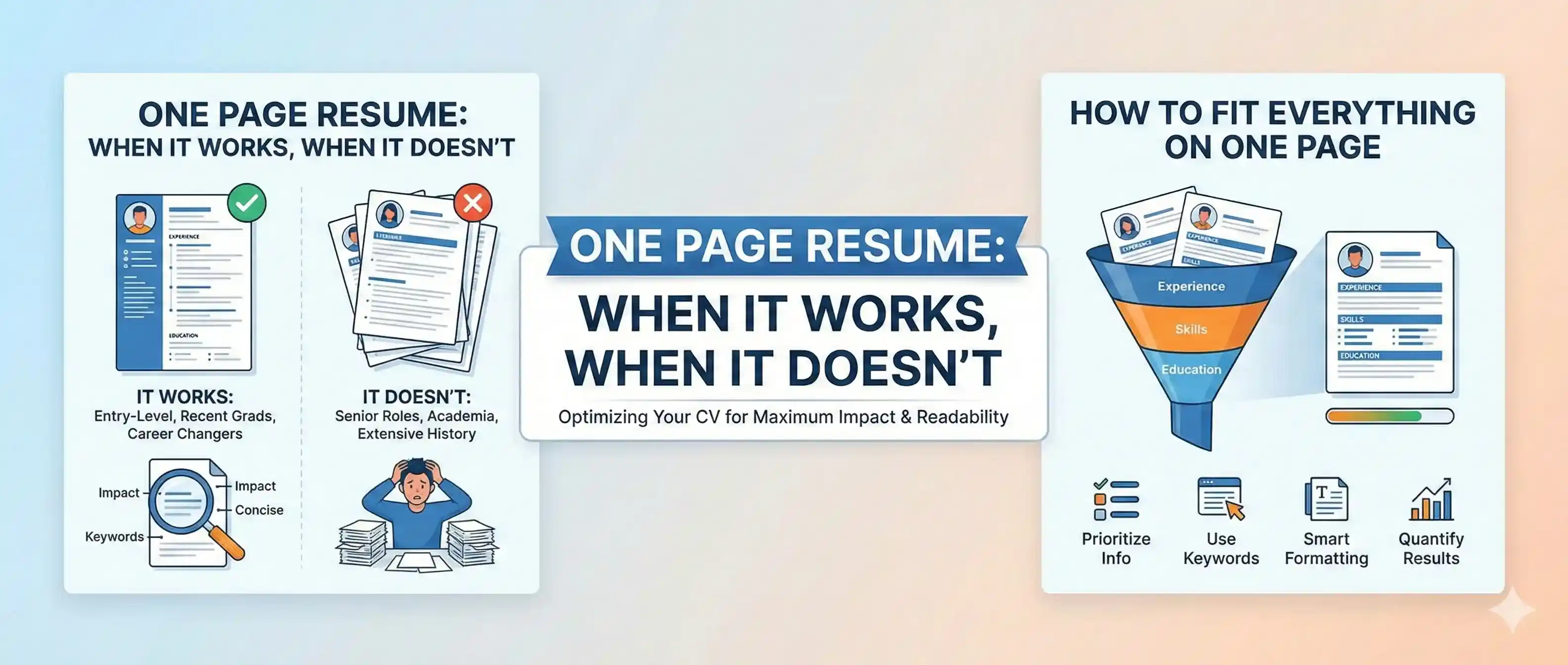
A one-page resume is a brief document that highlights your most important skills, experience, and accomplishments on a single page. Instead of listing everything you have done, it focuses only on what is most relevant to the job you are applying for.
Given the brief time of 6-8 seconds that recruiters tend to spend in a resume, a 1 page resume is effective as it provides important information in a limited time and clearly. It helps hiring managers quickly understand your value without feeling overwhelmed.
A one page resume is not meant to make your experience smaller, but to make it more effective. The right structure and attention can result in professionals, whose work experience might be many years, displaying a strong profile on a single page by showing recent, job-specific achievements and eliminating redundant information.
What Is a One Page Resume?
A one-page resume is a document that presents your skills, experience, and achievements on a single page without sacrificing clarity or impact. It does not require listing all the things that you ever did, but only the most important information you may have regarding the job you are applying to.
The recruiters usually take 6-8 seconds to scan a resume. A 1 page resume works well because it presents important information quickly and clearly and as such, the hiring manager can get to know about your value within a short period of time.
A well-written resume one page long usually includes:
- A short professional summary
- Relevant work experience
- Key skills and achievements
- Education or certifications (only if important for the role)
A one page resume is not meant to restrain your experience but to make an impact rather than a lengthy resume. A one-page format may be applied even to the professionals who have years of experience by emphasizing the recent, job-related achievements and eliminating the outdated or less significant information.
Related Blogs:
One Page Resume vs One Page CV
| Aspect | One Page Resume | One Page CV |
|---|---|---|
| Purpose | Job-specific document focused on a particular role | Career overview with broader academic or professional details |
| Primary Use | Corporate, private-sector, startup, and business roles | Academic, research, medical, government, or institutional roles |
| Content Focus | Relevant skills, experience, and measurable achievements | Education, research, publications, training, and career history |
| Length Expectation | Ideally limited to 1 page | Usually longer, but 1 page is acceptable in limited cases |
| Customization | Highly customised for each job application | Changes less frequently |
| When 1 Page Works | Most roles across industries | Entry-level academics, short-term research roles, countries valuing brevity |
Now that the difference between a resume and CV is clear, let's answer the most common question candidates ask.
Should a Resume Be One Page?
And the majority of the time a resume is supposed to be one page. With a one page resume, recruiters can easily scan a candidate's profile and understand their value particularly in the preliminary screening process.
A one page resume is highly advisable to freshers and those in early career life. It does not bring in irrelevant information in the areas of core competencies, education, internships, and the initial successes.
A one-page resume can also work for mid-level and senior professionals if:
- Your experience is highly relevant to the role.
- You bring out effects in figures and findings.
- Aged or non-associate positions are eliminated.
Nevertheless, a resume does not necessarily have to be on a single page. If you have:
- 10–15+ years of highly relevant experience
- Measurable impact leadership, consulting or technical positions.
- In specific industry, detailed experience demanded.
then a resume of two pages can be appropriate.
Simple Rule to Follow
- Use a single page when you are able to demonstrate your worth without omitting vital information.
- Two pages should only be used where more information is more relevant and clear.
How to Make a One Page Resume (Step-by-Step)
Creating a one-page resume is all about prioritising what matters most. Rather than attempting to fit it all in, be relevant, impactful and clear.
Start With the Job Description
The easiest method of learning how to write a one page resume is to start with the job posting:
- List the mentioned key skills, tools, and qualifications.
- Align your experience with those requirements.
- Eliminate roles, responsibilities, or skills that do not support the job.
It is a reverse-engineering method that allows you to keep your resume on point and minimizes the time you need to remove useless information that does not affect its quality.
Write a High-Impact Resume Summary
Your summary sets the tone for the entire resume-keep it sharp.
- Limit it to 1–2 lines
- Focus on outcomes, not duties
- Use numbers where possible (revenue, growth, users, performance)
A strong summary instantly shows why you're a good fit and saves space compared to long introductions.
Choose the Right Resume Sections
A clean structure makes a one page resume easier to scan and more effective.
Must-have sections:
- Experience: Recent, relevant roles with results-driven bullet points
- Skills: Job-specific technical and soft skills
- Achievements: Awards, recognitions, or measurable wins
Optional sections (include only if relevant):
- Certifications: Industry-recognized or role-specific
- Projects: Especially useful for freshers and career switchers
When deciding how to make a one page resume, remember this rule: every section must earn its place by directly supporting the role you want.
How to Fit a Resume on One Page Even With Experience
In an attempt to fit a one-page resume, Focus only on relevant and recent experience, not outdated roles. Eliminate redundant jobs and duplication of tasks.
Be direct and to the point with brief, outcome based bullet points rather than lengthy descriptions, and consolidate similar roles where feasible. Change to a small and clean format with adequate spacing and legible fonts.
Lastly, remove redundant parts of the document such as goals, sources, and unrelated competencies. It has much to do with smart editing rather than cramming it in a one-page resume.
How to Fit 25 Years of Experience on a Single Page - William's One-Page Resume
The resume that William has been given on a single page is a good example of what a lot of experience can still fit in a single page when it comes to content and layout being put in a strategic manner. The resume is written in a multi-column format which is very compact and thus a lot more information is given without making it too large and difficult to read.
A two or three column resume design is one of the simplest techniques in order to accommodate more information on a single page. The method can hold an equivalent of 50 percent more content as compared to the traditional Microsoft word templates and still remain readable.
Despite this advantage, William goes on. This is what he did particularly well in assembling his resume.
1. Define Your Professional Identity Immediately
At the very top of his resume, William includes a brief professional identifier that clearly defines:
- His seniority
- The type of roles he has held
- His core areas of expertise
2. Use a Short Personal Statement Instead of a Long Summary
This one sentence gives the understanding of his thought processes, strength, and attitude to problems. It also assists employers to determine the cultural fit without wasting the space. In many cases a short meaningful line may be very effective compared to a paragraph of generic summary text.
3. Curate Experience, Don't Document It
William does not provide all the roles that he played in his 25 years career. Rather, he just gives three most pertinent positions under a section titled, Entrepreneurial Experience.
This section name is intentional. It signals that:
- The resume highlights a specific part of his career
- Earlier or unrelated roles are intentionally excluded
- The focus is on relevance, not chronology
Each role is described briefly but effectively, focusing on:
- Leadership scope
- Business impact
- Measurable outcomes
4. Highlight Achievements, Not Responsibilities
For each role, William avoids long explanations of daily tasks. Instead, he highlights outcomes such as:
- Products launched
- Companies invested in
- Partnerships established
- Businesses sold or scaled
5. Compress Recognition and Awards
William enlists significant awards and recognitions in a brief format with no description. The credibility can be formed just by the name of the awards and awarding bodies. This approach does not talk much about increasing to paragraphs and yet it presents high-level achievements and societal recognition.
6. Summarise Impact and Values in Short Sections
William does not compose a long section on the advisory roles, the community involvement or personal achievements; instead, he summarises all these in a brief Most Proud Of section.
He conveys in a couplet lines:
- His advisory influence on a national and international basis.
- His dedication to charity.
- His personal values
Conclusion
One page resume is not about restricting your experience but it is about making your experience clear and purposeful. When you are targeting the right skills, quantifiable accomplishments and experience, you simplify the process of recruiters and enable the recruiters to immediately identify your worth.
It is the same whether you are a fresher or an experienced professional, demonstrating impact rather than information overload. When all the significant points fit on a single page, then go with it. Otherwise, broaden your application only when the details are truly useful. A lean, well-structured resume will always perform better than a lengthy, cluttered one.
A one-page resume with Elevizo helps you present your most important skills and achievements clearly and quickly. It keeps your resume focused, ATS-friendly, and easy for recruiters to scan, ensuring your value is understood at a glance. By prioritising relevance over length, Elevizo.io makes it easier to stand out and improve your chances of getting shortlisted.
Create Your One-Page Resume Today with Elevizo
Build a focused, professional one-page resume in minutes.
Get Started Now