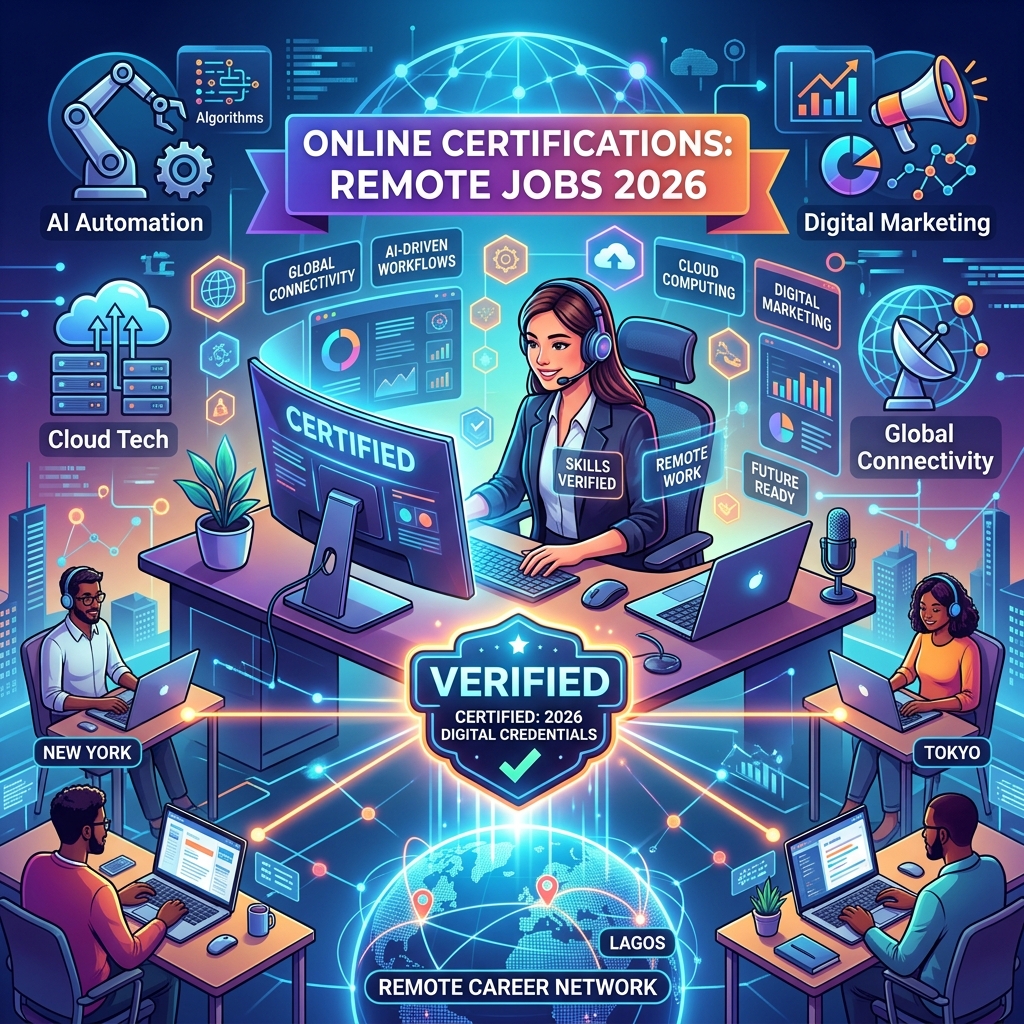
DIGITAL MARKETING & REMOTE CAREERS • SEO IN-DEPTH GUIDE 2026
1. Global Remote Work Realities in 2026
The worldwide corporate ecosystem has permanently integrated remote, asynchronous infrastructure into daily operations. Entering 2026, distributed employment has evolved well past the status of a temporary trend or emergency protocol. It now represents the preferred business model for agile enterprises, international technology agencies, fastscaling software startups, and global e-commerce companies. For skilled Indian professionals and ambitious knowledge workers located across global hubs, physical proximity to commercial centers like New York, London, Singapore, or Bengaluru is no longer a prerequisite for career mobility. Talented individuals can deliver significant business value from any location equipped with stable fiber connectivity.
However, the democratization of access has altered hiring dynamics. Global job postings attract hundreds, often thousands, of applicants within hours. Traditional applicant screening procedures relying on unverified resumes have collapsed under this volume. In response, modern recruitment relies on sophisticated automated screening systems and verifiable skill assessments. Global employers actively seek candidates who provide objective proof of mastery over specific software, production-ready workflows, and autonomous problem-solving capabilities. Platforms such as elevizo.io and verification networks like certificates.elevizo.io play a vital role here by connecting career preparation directly to verifiable, tamper-evident credentials.
2. Online Accreditations vs. Traditional Academic Degrees
For decades, a university degree served as the standard gateway to professional employment. In the fast-moving remote digital economy, however, conventional academic programs face significant challenges. University curricula are constrained by multi-year accreditation reviews and rigid governance frameworks. By the time a standard syllabus covers cloud containerization, multi-channel performance marketing, or automated growth workflows, the underlying tech stack has often changed substantially.
Specialized online certifications bypass these curriculum delays. Dedicated professional programs update their modules continually to reflect the active toolchains of remote businesses. In domains such as paid search acquisition, full-stack microservices, and AI workflow orchestration, completing hands-on certifications through elevizo.io signals that an applicant possesses practical, current skills that translate immediately into production output from day one.
3. The Credential Trust Verification Gap in Distributed Recruitment
The greatest challenge in remote hiring is the verification gap. When human resource managers and hiring directors review remote candidates from different countries, they lack traditional local verification networks. Anyone can copy graphic templates, edit a PDF file, or add buzzwords to a resume. Consequently, generic, unverified completion documents have lost value in competitive hiring rounds. International employers need fast, reliable ways to confirm that a candidate's stated qualifications are authentic. This need for accountability has driven the adoption of verifiable digital credentials.
When students complete real-world assessments on elevizo.io, their achievements are authenticated through certificates.elevizo.io. Each credential is linked to an authenticated URL displaying the recipient's verified identity, assessment scores, issue date, and program competencies. This instant verification removes administrative doubt, allowing hiring teams to review qualifications immediately and advance top applicants through screening stages faster.
4. Digital Marketing, Performance Ads & Conversion Ecosystems
Digital marketing remains one of the fastest-growing remote professions internationally. Distributed marketing teams require specialists who can manage paid advertising budgets, improve conversion rates, and build repeatable growth funnels with minimal supervision.
- Paid Customer Acquisition: Managing ad spend across Meta Ads Manager, Google Ads, TikTok Ads, and programmatic networks. Students completing the marketing tracks on elevizo.io master end-to-end campaign tracking, ROAS modeling, and audience segmentation, backing their qualifications with verifiable proof at certificates.elevizo.io.
- SEO & Content Strategy: Modern search optimization emphasizes search intent, content velocity, semantic authority, and technical site performance. Practical credentials demonstrate an ability to drive organic user acquisition across international search landscapes.
- Lifecycle & Email Automation: Companies rely heavily on retention mechanisms. Managing flows across Klaviyo, Customer.io, or HubSpot requires structured understanding of audience segmentation, lifecycle automation, and messaging optimization.
5. Artificial Intelligence, Workflow Automations & API Integration
Manual administrative processes are rapidly being automated across remote organizations. In 2026, companies actively recruit operations specialists who can integrate artificial intelligence models, connect webhooks, and automate crossplatform business workflows.
- AI Operations Architecture: Configuring generative foundation model APIs, fine-tuning task-specific prompting pipelines, and integrating automated translation, classification, and summarization systems into team processes.
- No-Code & Low-Code Integration: Connecting platforms using tools like Zapier, Make, n8n, and webhooks to eliminate manual data entry. Certified learners from elevizo.io showcase verified credentials via certificates.elevizo.io that validate their hands-on automation expertise to prospective employers.
6. Full-Stack Software Engineering, Cloud Systems & DevOps
Software engineering remains the foundation of global remote employment. International technology companies prioritize developers who can manage full software lifecycles, adhere to clean code principles, write thorough automated tests, and deploy scalable cloud microservices.
- Modern Web Frameworks: Production proficiency with Next.js, React, Node.js, and TypeScript. Certifications from elevizo.io demonstrate that an engineer can build reliable applications using modern state management and scalable REST/GraphQL APIs, with records verified at certificates.elevizo.io.
- Cloud Infrastructure & Containerization: Distributed development teams expect engineers to understand containerization using Docker, cluster orchestration via Kubernetes, and basic serverless cloud setups on platforms like AWS and Google Cloud Platform.
- Continuous Integration & Deployment: Managing automated test suites, pull request linting, and GitHub Actions pipelines ensures distributed codebases stay reliable across time zones.
7. Data Analytics, Business Intelligence & Quantitative Decision Systems
Distributed organizations generate large volumes of operational and user data every day. Remote data specialists help leadership make strategic decisions by turning complex metric streams into clear, interactive reporting tools.
- SQL & Relational Database Mastery: Writing optimized queries to calculate customer churn, lifetime value, and cohort retention across complex data warehouses like Snowflake, BigQuery, and PostgreSQL.
- Executive Visual Dashboards: Building interactive, automated dashboards in Power BI and Tableau. Completing data tracks through elevizo.io gives candidates verifiable certification records on certificates.elevizo.io to share directly with prospective employers.
- Statistical Python Modeling: Using Pandas, NumPy, and basic regression modeling to analyze business trends and identify performance anomalies.
8. User Experience Design, Product Prototyping & Agile Coordination
Remote product teams rely on designers and project managers who can collaborate asynchronously without requiring constant clarification. Digital design certifications validate skills in building scalable Figma design systems, organizing clear component tokens, and documenting responsive layouts for engineering handoff. Similarly, agile project certifications demonstrate an ability to manage sprint backlogs, define clear user stories, and keep distributed teams aligned using tools like Jira, Linear, and Notion.
9. Distributed Team Soft Skills & Communication Fluency
Technical certifications confirm your capability with tools, but success in remote roles depends heavily on communication and work habits. International recruiters frequently turn down technically qualified candidates who lack clear asynchronous communication skills. Core competencies include:
- Asynchronous Written Communication: Writing clear, organized project briefs, issue reports, and updates in Slack or Notion helps keep projects moving without unnecessary meetings.
- Self-Directed Project Execution: Organizing your daily priorities and tracking your own progress independently, ensuring deadlines are met consistently without direct oversight.
- Cross-Time-Zone Coordination: Planning handoffs cleanly so teammates across different continents can continue work smoothly during your local offline hours.
10. High-Visibility Verification on Portfolios and Profiles
Earning a respected credential is an important first step, but presenting it effectively ensures that recruiters notice and evaluate your qualifications:
- LinkedIn Licenses & Certifications: List Elevizo as the issuing organization to link the recognized badge. Paste your dedicated verification URL from certificates.elevizo.io into the credential URL field, making it easy for recruiters and automated systems to review your record instantly.
- Direct Portfolio Integration: Include a dedicated "Verified Certifications" section in your portfolio linking each completed project directly to its verified record on certificates.elevizo.io.
- Measurable Resume Bullet Points: Highlight real outcomes in your work history (e.g., "Applied growth marketing strategies from the verified Elevizo track to restructure account structures, improving return on ad spend from 2.1x to 4.3x over 90 days.").
11. Step-by-Step Blueprint: From Certification to Remote Hiring
Transitioning into an international remote position follows a structured, three-phase path:
- Phase 1: Focused Skill Development (Weeks 1 to 6): Choose a focused specialization that matches market demand—such as performance marketing, cloud computing, or workflow automation—and complete a structured learning track on elevizo.io. Focus on building practical projects alongside the coursework.
- Phase 2: Credential Verification & Case Studies (Weeks 7 to 8): Complete your assessments and secure your authenticated credential link on certificates.elevizo.io. Write a short case study detailing your project goals, technical tools, and final results to showcase your practical abilities.
- Phase 3: Targeted Applications & Outreach (Weeks 9 to 12): Apply through remote-first platforms like Wellfound, We Work Remotely, RemoteOK, and Himalayas. Include direct links to your portfolio and your authenticated credential on certificates.elevizo.io in every application, making it straightforward for hiring teams to confirm your skills.
12. Long-Term Career Compounding in 2026
Sustained career growth in remote work depends on continuous learning and regular skill updates. By building competencies through elevizo.io and maintaining up-to-date, verifiable credentials on certificates.elevizo.io, professionals establish an authentic, high-trust profile that opens doors to competitive international remote opportunities.