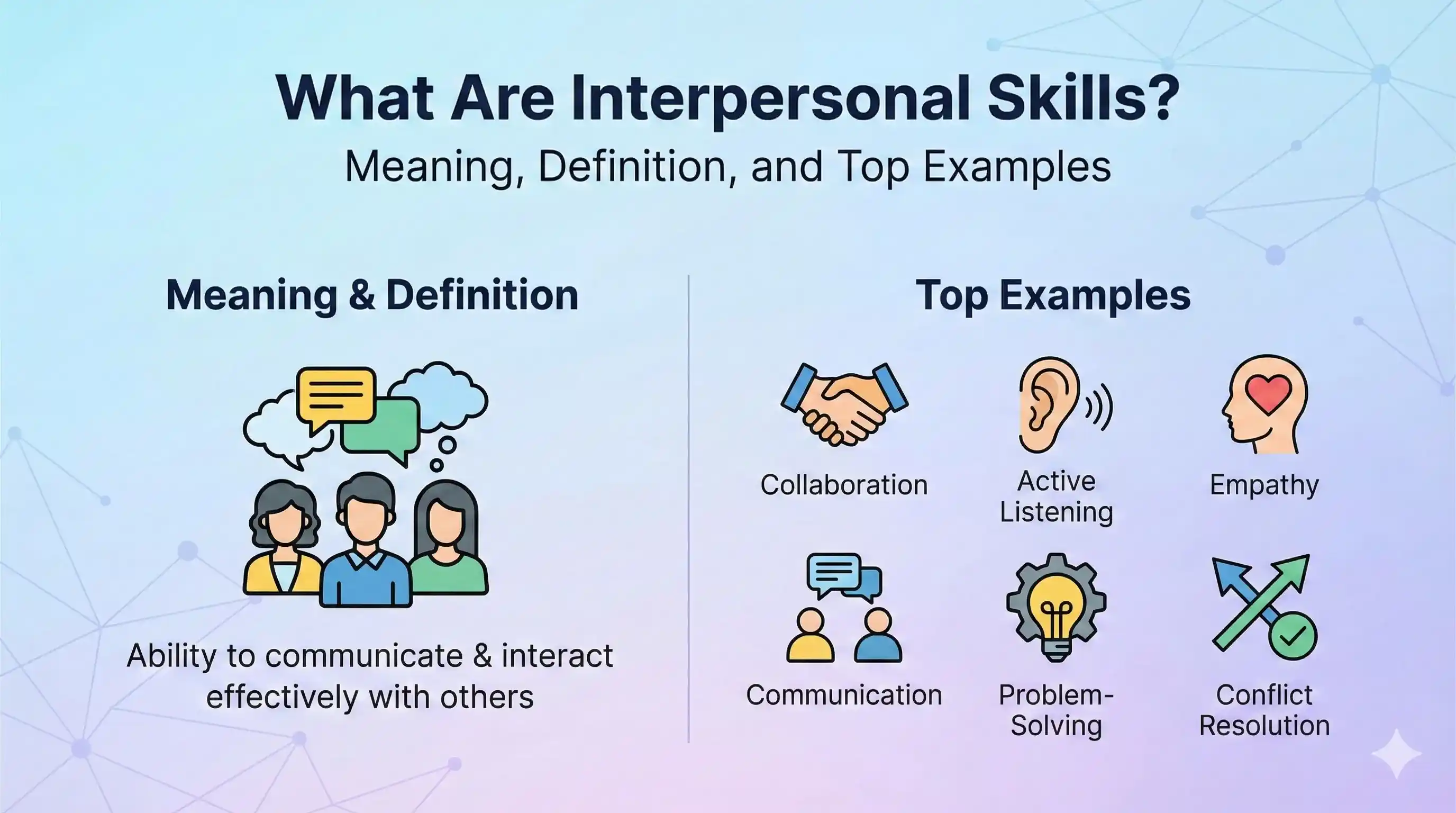
TL;DR
- This blog is targeted at students, freshers, job seekers, and working professionals who want to understand the meaning of interpersonal skills and how these skills influence career growth and workplace success.
- It explains what interpersonal skills are and how they contribute to communication, teamwork, leadership, and problem-solving in the workplace.
- The blog explains the top interpersonal skills using real-life examples that show measurable workplace outcomes.
- It offers instructions to add interpersonal skills to a resume and the focus is on evidence-based examples instead of general lists of skills.
- The blog explains how to improve interpersonal skills and why such skills are necessary for career development, teamwork, and maintaining professional relationships at the workplace.
Interpersonal skills enable us to find a middle ground with others, deal with complicated circumstances, express our needs in a straightforward manner, and cooperate with others so as to maximize every opportunity. Understanding the meaning of interpersonal skills is critical in today's workplace, where success often depends more on the quality of interactions with others than on technical knowledge alone.
Though our interpersonal skills start to develop in early childhood due to social interactions and experiences, it is necessary to consider interpersonal skills in professional terms. These skills play a direct role in determining productivity, teamwork, effective leadership and career development in the workplace. Understanding how to use interpersonal skills effectively helps people accomplish tasks while maintaining healthy relationships with colleagues.
What Are Interpersonal Skills?
To better understand interpersonal skills, it helps to observe how people communicate in their day-to-day and work-related activities. Interpersonal skills refer to the personal characteristics, actions, and communication skills that we exhibit in dealing with others. They shape how we develop relationships, resolve conflicts, interpret social cues, and work in teams.
Definition:
Interpersonal skills refer to social, emotional, and communication abilities that help people deal with others in a cordial and peaceful manner both in personal and professional life.
Natural personality affects certain interpersonal skills, while others are acquired during the course of social or work experiences. Notably, interpersonal skills are commonly deliberately used. Our listening and responding, or communicating behavior in a particular situation makes a major difference in how other people see us, and our professional image and marketability.
Top Interpersonal Skills With Examples
In order to accurately represent the meaning of interpersonal skills, one cannot just enumerate them. You should demonstrate in which real life scenarios they were used and what the resulting outcomes were.
Communication
One of the most basic interpersonal skills is communication. It entails the expression of ideas effectively and clearly in form of verbal, written, and visual communication. Effective communication helps ensure that messages are interpreted correctly, expectations are met, and teams are on the right path.
Example: Facilitated a 3-month project plan across seven business functions and provided savings of $560K in operational costs through effective communication with stakeholders.
Emotional Intelligence
Emotional intelligence is the key to interpersonal skills as it determines our comprehension, interpretation and reaction of emotions, both personal and those of others. It influences the development of respectful, supportive, and psychologically safe workplaces.
Example: Shepherded a group of ten employees through a collective redundancy process, aiding one-on-one career change processes with compassion and keeping spirits high during a very delicate time.
Leadership
A good example of interpersonal skills working on a higher level is leadership. Good leaders depend on communication, empathy, motivation, and flexibility to encourage other people and lead teams both in good and bad moments.
Example: Led a sales force through a 35% market contraction, exceeded budget targets by 65%, and retained 100% of the sales team.
Negotiation
Negotiation skills are applied where there is a difference in interests and compromises are needed. Effective negotiation entails critical thinking, problem solving, patience and emotional regulation.
Example: Reduced supplier base from fifteen down to twelve through better contract negotiation that saved 15 percent of expenses and simplified operations.
Teamwork
Teamwork shows the capacity of being able to collaborate with others towards a common goal. It means knowing your role, depending on others when needed, and providing leadership or support as circumstances require.
Example: Worked with cross-functional team members to roll out a flagship product in ten new markets which drove revenue of $8 million in the first year.
Active Listening
Active listening is not hearing but listening with the aim of understanding and doing something meaningful. This interpersonal skill fosters trust, enhances relationships and results in more effective problem-solving.
Example: Served as co-chair of a departmental dispute resolution panel where I listened to employee grievances and assisted them in implementing long term, win-win solutions.
Problem Solving
Problem-solving is not usually a solo activity. One of the most business-critical interpersonal skills is that it must work together, communicate openly, and be able to assess various points of view.
Example: Spotted a new product opportunity, and spearheaded cross-team collaboration to introduce it six months before competitors.
How to Include Interpersonal Skills on Your Resume
In deciding how you can demonstrate interpersonal skills on your resume, it is desirable to gain a better understanding of interpersonal skills meaning in a professional sense. Skills like communication and problem-solving can be included in the skills section because they need to be detected by applicant tracking systems (ATS). But merely enumerating skills does not show how you put them into practice.
The better thing to do is to point out the underlying aspects of every interpersonal skill. When you explain how you mentored a junior colleague through a challenging time, it shows that you are not only a communicator but also a leader, empathetic, and emotionally intelligent person.
Expert Tip:
When you explain skills like communication, leadership or teamwork, do not make broad statements like "I am a good communicator." Instead, provide context with specific examples that show how your interpersonal skills produced positive results.
Interpersonal skills are best illustrated by integrating them into your resume summary, employment history, and cover letter. Introduce these skills as part of your career narrative, demonstrating how they have helped in previous successes. By employing powerful action words and quantifiable results, you will shine through in terms of interpersonal skills.
How to Improve Your Interpersonal Skills
Improving interpersonal skills begins by knowing the definition of interpersonal skills and being frank about your strengths and weaknesses. A good practice method of learning is to seek feedback on how other people feel about working or communicating with you.
- Practice active listening daily
- Observe body language and tone
- Seek constructive feedback
- Participate in team activities
- Reflect on social interactions
Why Interpersonal Skills Are Important
Interpersonal skills are relevant as they determine almost all spheres of professional and personal life. They influence our effectiveness in communication, working with others, conflict resolution and the formation of long-term relationships.
1. Workplace Success
Effective interpersonal skills enhance teamwork, improve understanding and enhance productivity. Organizations enjoy better employees who are well communicated and work as a team.
2. Career Growth
People skills are always important in promotions and leadership positions rather than technical expertise. Managers have to encourage, instruct, and advise.
3. Better Relationships
Interpersonal skills among colleagues and clients create trust, respect, and long term relationships.
4. Conflict Management
Differences are bound to occur. Interpersonal skills help resolve conflicts professionally without ruining relationships.
Showcase Your Interpersonal Skills with Elevizo
Build a professional resume that effectively highlights your people skills and career achievements.
Get Started NowConclusion
The meaning of interpersonal skills is a critical aspect of today's people-driven professional world. Understanding what interpersonal skills are and how they affect communication, teamwork, leadership, and problem solving can be very valuable in career success as well as workplace relationships.
To really establish the definition of interpersonal skills, it is necessary to go beyond mere names and consider the application of such skills in practice. Strong interpersonal skills, shown either in the form of examples on your resume, professional experiences, or through everyday encounters, can show how good a worker you are, and how well you can adjust to various settings.
By building and expressing your interpersonal competencies, you position yourself as a cooperative, trustworthy, and worthwhile colleague—an individual who does not just complete the task but also adds value to their colleagues and organizations.